

Chances are that when most Ventura County residents think of Oxnard Airport, they think of current operations made up of mostly flight training and businesses including Golden West Jet Center, Aspen Helicopters, and California Aeronautical University (CAU). Mixed in are likely memories of when the airport’s terminal was bustling with commercial travelers heading to distant destinations, and of the critical part the airport played for the Army Air Corps and Navy during World War II.
What many arguably don’t know is that Oxnard Airport’s role extends well beyond traditional airport operations and into the realm of national non-profit organizations that focus on environmental conservation, life-changing flights to medical appointments, and animal rescue and sheltering – all made possible by locally based pilots who volunteer their time, fuel, and planes to conduct missions aimed at making a difference.
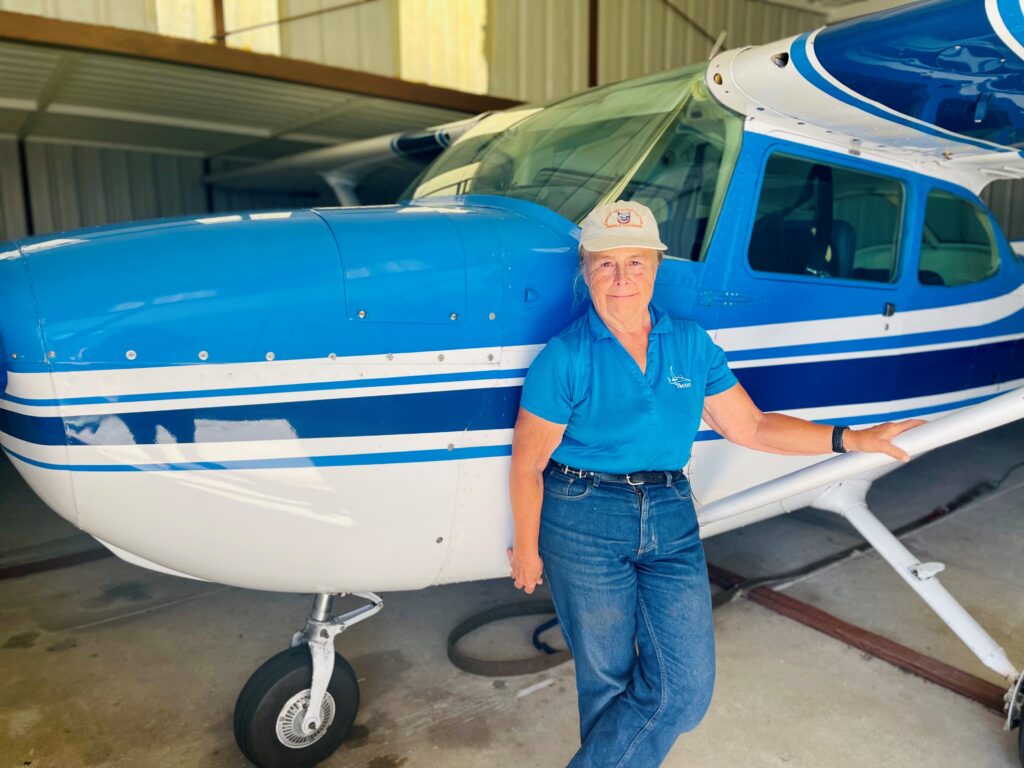
Among those pilots is Barb Filkins, a Ventura County resident based at Oxnard Airport. Of the many hats she wears (literally and figuratively) there is one that bears the image of the Channel Islands Fox. In 2020, just as the COVID-19 pandemic was worsening, Filkins became a volunteer pilot for LightHawk, an aviation focused non-profit organization that operates nationally with the goal of contributing to nature conservation efforts.
“It was a new challenge,” Filkins said. “And their mission is fitting for me.”
For three years, Filkins has flown regular missions for LightHawk, a partner of the Nature Conservancy, conducting missions for the Channel Islands Fox count. She flies her Cessna 172 over each of the islands, with the exception of Anacapa Island where the foxes do not live.
Accompanied by scientists from the Nature Conservancy and California Institute of Environment Studies, Filkins’ flies at 3,500-4,500 feet above sea level as the scientists use the transmissions from the antenna attached to the plane to communicate with the collars worn by each of the endangered foxes. Those transmissions allow scientists to determine movement and overall activity levels of the fox population during each of the monthly missions.
Filkins will soon add to her LightHawk resume with missions for the California Condor count as part of a partnership with the Santa Barbara Zoo. She will use the same plane but a different antenna that will communicate with the tags that are glued to feathers of each condor.
“This will be a unique challenge,” Filkins said. “You’d think it would be simple because we are looking for just five or six condors at a time. But they can fly up to 300 miles a day, making it difficult to find them. Our flight range will be from Ventura County to Yosemite.”
For more information regarding this story and others, visit airports.venturacounty.gov. To learn more about LightHawk, visit lighthawk.org.